
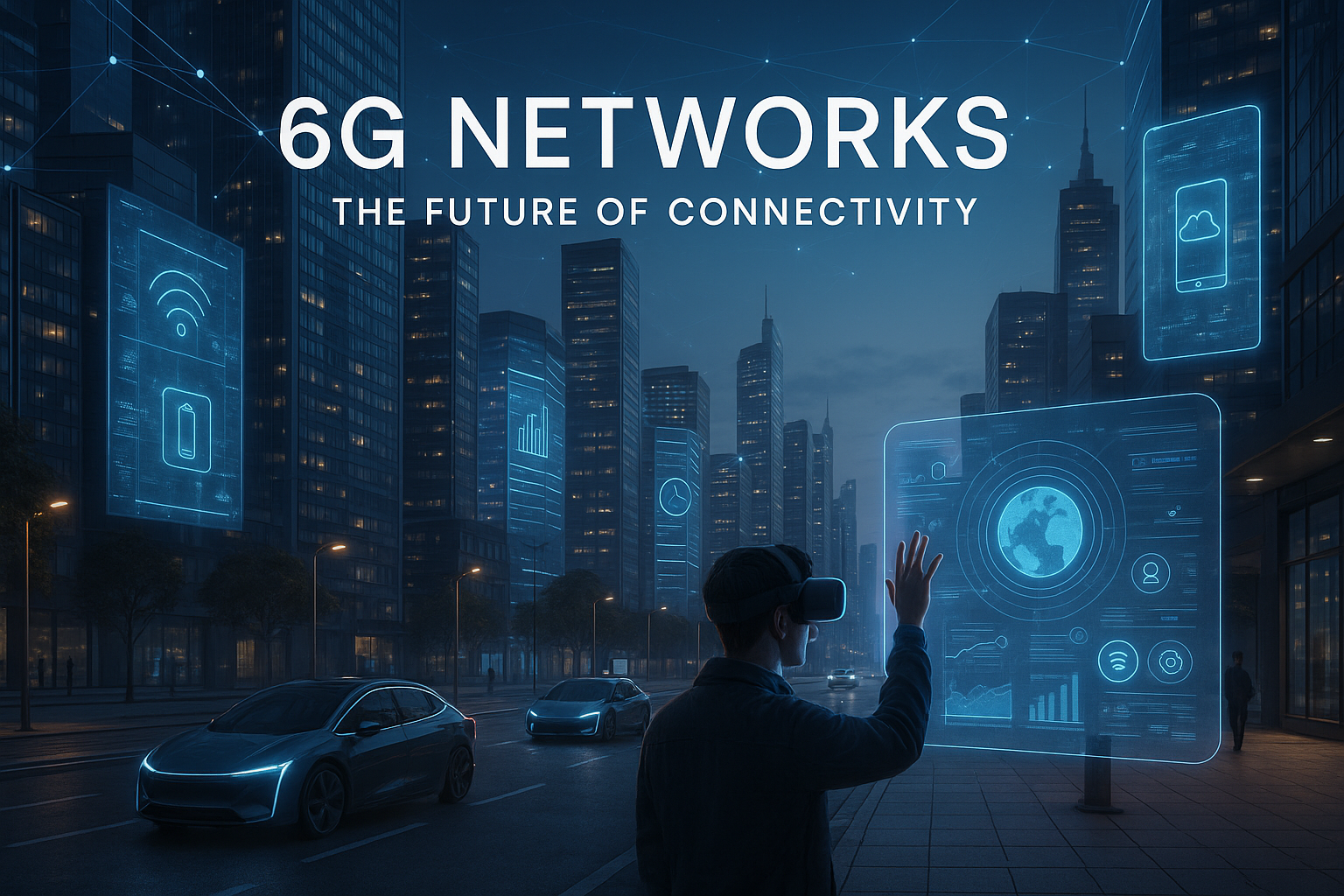
Introduction
The world is still adapting to 5G networks, but the horizon already holds the promise of 6G technology. Expected to arrive around the 2030s, 6G promises to surpass 5G in speed, connectivity, and intelligence, enabling innovations that were previously unimaginable. While 5G has already enhanced mobile internet, smart devices, and real-time communication, 6G will redefine how humans, devices, and machines interact on a global scale.
From ultra-fast downloads and seamless augmented reality experiences to AI-driven networks and global connectivity, 6G is poised to be the backbone of the next digital revolution. In this blog, we’ll explore what 6G is, its potential applications, benefits, and how it will change the world.
1. What is 6G?
6G stands for the sixth generation of wireless communication technology, succeeding 5G. While 5G brought speeds up to 10 Gbps, low latency, and massive device connectivity, 6G is expected to push the limits further:
- Data speeds: Estimated up to 1 Tbps, enabling instantaneous downloads of massive data
- Latency: Near-zero latency for real-time interactions
- Connectivity: Seamless global coverage including remote areas and oceans
- AI Integration: Intelligent networks that can self-optimize based on user needs
6G networks will not just be faster; they will be smarter, more adaptive, and capable of supporting entirely new digital ecosystems.
2. Key Technologies Behind 6G
Several cutting-edge technologies will make 6G possible:
a. Terahertz Frequency Bands
6G will operate in terahertz (THz) frequency bands, which provide ultra-high-speed data transmission far beyond 5G capabilities.
b. AI-Powered Networks
AI and machine learning will manage network traffic, predict congestion, and optimize energy usage in real-time.
c. Edge Computing
Processing data closer to users reduces latency, enhances reliability, and supports massive IoT ecosystems.
d. Holographic and XR Communication
6G will support high-definition holograms, augmented reality (AR), and virtual reality (VR) applications for immersive experiences.
e. Satellite and Global Coverage
Integration with low-earth orbit (LEO) satellites will bring reliable high-speed connectivity to rural and remote regions globally.
3. How 6G Will Transform Communication
Ultra-Realistic Video Calls
- Holographic calls where participants appear as lifelike 3D images
- Real-time interaction with gestures and expressions
- Virtual presence for business meetings, education, and personal communication
Global Connectivity
- Seamless internet anywhere on the planet, including oceans, deserts, and mountains
- Enabling communication in areas previously unreachable
6G will make physical distance almost irrelevant, connecting humans like never before.
4. Impact on Entertainment and Media
6G will revolutionize entertainment by making it immersive, interactive, and instantaneous:
Applications include:
- Holographic concerts and live events: Attend virtual performances as if you’re physically present
- Ultra-realistic gaming: VR and AR experiences with near-zero latency
- On-demand content: 3D movies, interactive TV, and live-streaming in real-time
- Cloud-based AR/VR environments: Play and interact with anyone globally without lag
6G will blur the line between reality and virtual experiences, creating fully immersive entertainment.
5. Advancements in Healthcare
6G’s high-speed, low-latency networks will enable unprecedented healthcare innovations:
- Remote surgeries: Surgeons can operate robotic systems from thousands of miles away with precision
- Real-time patient monitoring: Wearables and medical devices connected via 6G for instant updates
- AI-assisted diagnosis: Immediate analysis of complex medical data
- Telemedicine anywhere: Rural and remote regions gain access to high-quality healthcare
6G will make healthcare faster, smarter, and more accessible than ever before.
6. Revolutionizing Education
Education will evolve with 6G by enabling immersive, personalized learning experiences:
- Virtual classrooms in holographic 3D
- Interactive AR/VR simulations for science, history, and engineering
- AI-driven personalized tutors that adapt to students’ learning style
- Global learning networks connecting students and teachers worldwide
6G will make learning more engaging, effective, and accessible across the globe.
7. Smart Cities and Infrastructure
6G will accelerate the development of smart cities and connected infrastructure:
- Traffic management: AI-controlled traffic flow to reduce congestion
- Energy optimization: Smart grids and sensors monitoring electricity and water usage
- Public safety: Drones and IoT devices providing real-time alerts and surveillance
- Autonomous transport: Self-driving cars, buses, and delivery drones communicating instantly
The integration of 6G will make cities safer, greener, and more efficient.
8. Industrial Automation and IoT
Industries will experience unprecedented transformation with 6G:
- Smart factories: Real-time monitoring and AI-driven decision-making
- Autonomous logistics: Robots and drones working seamlessly in warehouses
- IoT device integration: Millions of devices communicating without latency issues
- Predictive maintenance: AI predicts equipment failures before they occur
6G will enable Industry 4.0 and beyond, making manufacturing smarter and more sustainable.
9. Environmental and Global Impact
6G could also help address global challenges:
- Climate monitoring: Real-time tracking of weather patterns and environmental changes
- Disaster response: Faster communication for emergency services
- Sustainable resource management: AI-driven insights for energy, water, and waste management
By connecting humans, machines, and sensors globally, 6G will enable more efficient and sustainable resource management.
10. Challenges and Considerations
Despite its promise, 6G faces challenges:
- Technical hurdles: THz communication, device compatibility, and energy efficiency
- Infrastructure costs: Massive investment in new networks and satellites
- Security concerns: Protecting global data from cyber threats
- Regulation: Ensuring ethical use of AI-driven communication
Addressing these challenges is essential to ensure 6G reaches its full potential safely and equitably.
Conclusion
6G is not just a faster version of 5G—it represents a paradigm shift in connectivity, intelligence, and human-machine interaction. By 2030, it is expected to revolutionize communication, entertainment, healthcare, education, smart cities, and industries worldwide. From ultra-fast holographic calls to AI-powered smart infrastructure, 6G will create a world where physical distance is irrelevant, technology anticipates our needs, and immersive experiences are the new normal.
The rise of 6G marks the next frontier in human innovation, connecting people, devices, and environments in ways previously limited to imagination. While challenges remain, the benefits promise a smarter, more connected, and sustainable future for the planet and humanity.